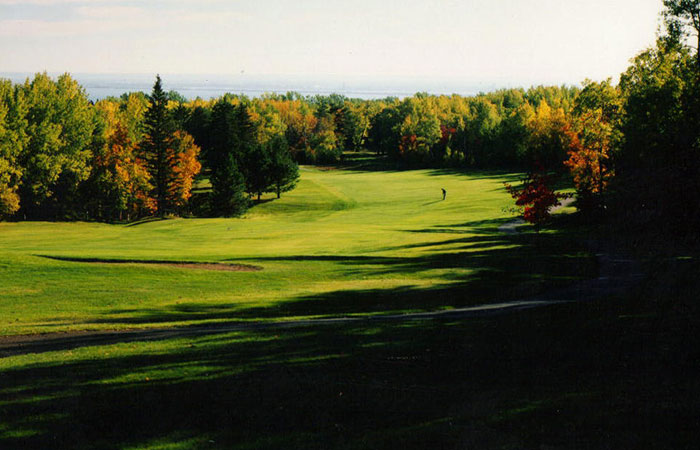
Hole 2
In start contrast to #1, the second hole is a short uphill, par 4. The tee shot often requires a long iron or fairway metal to find the small landing area short of the fairway bunker. The approach is blind to a well-bunkered green, which slopes severely from back to front. Stay below the hole!
Hole 3
Like #2, the third hole plays uphill, almost 100 feet. With a slight dogleg considerably longer though, a well-hit drive in the fairway is critical. The approach is blind to a two-tiered green. Once on the putting surface, you’ll have a chance to catch their breath. Look back and you’ll discover the first of many spectacular views of Lake Superior.
Hole 4
The fourth hole is the first of the par 5s. The tee shot plays slightly uphill to a narrow landing area. A well-hit drive allows for a second shot over the creek, which runs across the fairway 80 yards short of the green. The putting surface slopes from back to front and some pin placements make getting up and down from above the hole close to impossible.
Hole 6
Hole 6 is a relatively short par 4 that gives players a short break before reaching the heart of the course. The landing area is wide and forgiving like the first. Players can run the ball onto the green through the approach area. But, much like the second and fourth holes, the green slopes back to front. Stay below the hole.
Hole 7
A long par 4, the undulating fairway adds to the length of the hole as players not carrying to the plateau have a more difficult mid to long iron approach. Also, adding to the length is the “false front” of the green, which rejects balls more often than not. The putting green is one of the largest at NCC. Par is an excellent score on this hole.
Hole 9
Following the longest par 3 is the longest of the par 5s. This hole requires three good shots for all but the longest of hitters. The tee shot favors a right to left shot to a large landing area. The second must negotiate a swale, which cuts across the fairway 30 yards from the green, where the fairway narrows. Accomplishing this, the third shot is a long pitch to a large, moderately bunkered green.
Hole 10
Considered by many as one of the state’s toughest holes, this par 4 is a monster. The tee shot is played to a landing area which slopes up and to the right. Balls landing short of the green are rejected, while anything landing on the green often runs off the back. Birdies here are extremely rare. Fortunately, making a 4 on this hole is making a 4 on this hole is accomplishment enough.
Hole 11
This is a short par 5, and position is critical. The tee shot is played to a small landing area 40 feet below the tee. A pond situated 200 yards from the green protects the integrity of this hole. While perfect tee shots make this green reachable in two, position on the second shot is key. The green slopes severely from back to front and is well-guarded by pines and a bunker. Fly the ball to the hole, keeping in mind that an up and down from behind the hole is nearly impossible.
Hole 12
This is a long par 3 which can be played a number of ways. Similar to the first, balls hit short and left have an excellent chance of landing on the green. Some shots missed left often carom onto the putting surface. Meanwhile, shots played at the right side of the green much avoid a bunker complex and a false front which prevent balls from rolling on.
Hole 13
This is a long par 4 which doglegs to the left. Tee shots played down the right side with a slight draw will find the fairway. Once in the fairway, the second shot plays deceptively downhill to a green flanked by two bunkers. Again, approach shots can be flown to the hole or bumped in through the approach area. By far, this is the flattest green on the course.
Hole 14
An extremely demanding par 4, the tee shot plays uphill to a large landing area and is protected on the right by a large bunker. The steepness of the landing area makes the tee shot play longer. Regardless of the position off the tee, the fun really begins with the second shot, which plays downhill to a large, undulating green. Two bunkers guard the left approach and keep balls in bounds. Balls finding the green can end up 60’ from the hole. Two putts from this distance here are rare. Saving par from long or right can also be an adventure. Par here feels a lot like birdie.
Hole 16
Also playing downhill, this is another long par 4 where accuracy off the tee is the key. The approach will play from a downhill lie to a green protected on the front right by a large bunker. Shots beyond the green have little chance of recovery. However, shots landing short and right will supply you with adequate room to get up and down.
Hole 18
The big finish — and it’s a challenge. The hole measures nearly 430 yards from the back tees. The tee shot plays deceptively uphill. The green is best approached from the right side of the fairway, which is well-guarded by a fairway bunker. Players missing the fairway may find their best chance at par with a pitch out and short iron to the large green, a steep slope from back right to front left. Stay below the hole!